DROPWEBS
Competitor Intelligence

Compare honestly, or do not compare at all.

Competitor Intelligence analyses competitor information you enter yourself, with every field labelled as actual, user-supplied, estimated or unavailable. You enter the competitors you care about, and Dropwebs analyses what you supply.

The problem

Most competitor dashboards cannot tell you where a number came from.

Competitor modules usually present a rival's rating and review count as measured fact, when it is really an estimate assembled from thin signals. You end up making decisions on numbers nobody can source, and you cannot defend them to a client who asks.

A number you cannot source is a number you cannot defend.

An estimated competitor figure is indistinguishable from a real one on screen.

Google does not publish another business's internal metrics, so nobody has them.

A comparison you cannot source is a comparison you cannot defend to a client.

What Dropwebs does: Competitor Intelligence lets you store legitimate public competitor information and compare it with your real Dropwebs metrics.

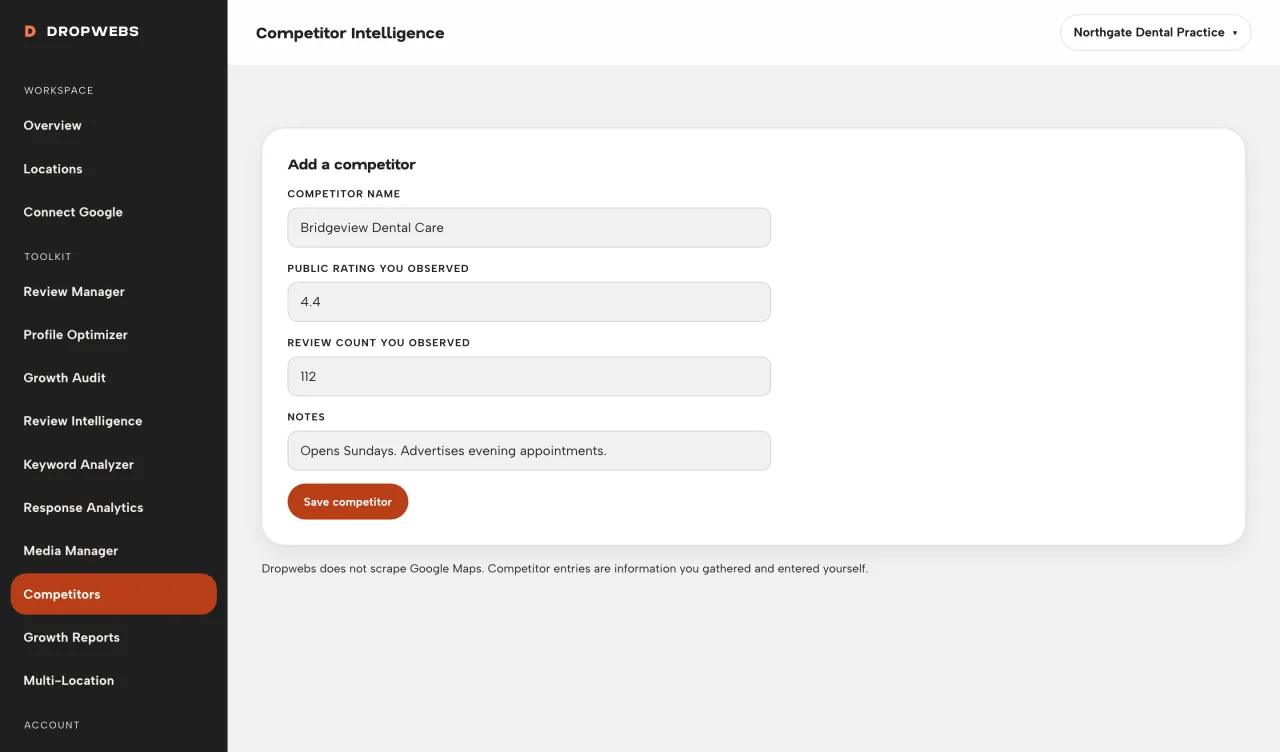
Adding a competitor with public information in Dropwebs Competitor Intelligence

Your inputs

Add the rivals that matter.

Add the competitors that matter, with the public rating and review count you can see on their profile. Dropwebs stores it against your account only, and every comparison shows exactly which figures you supplied.
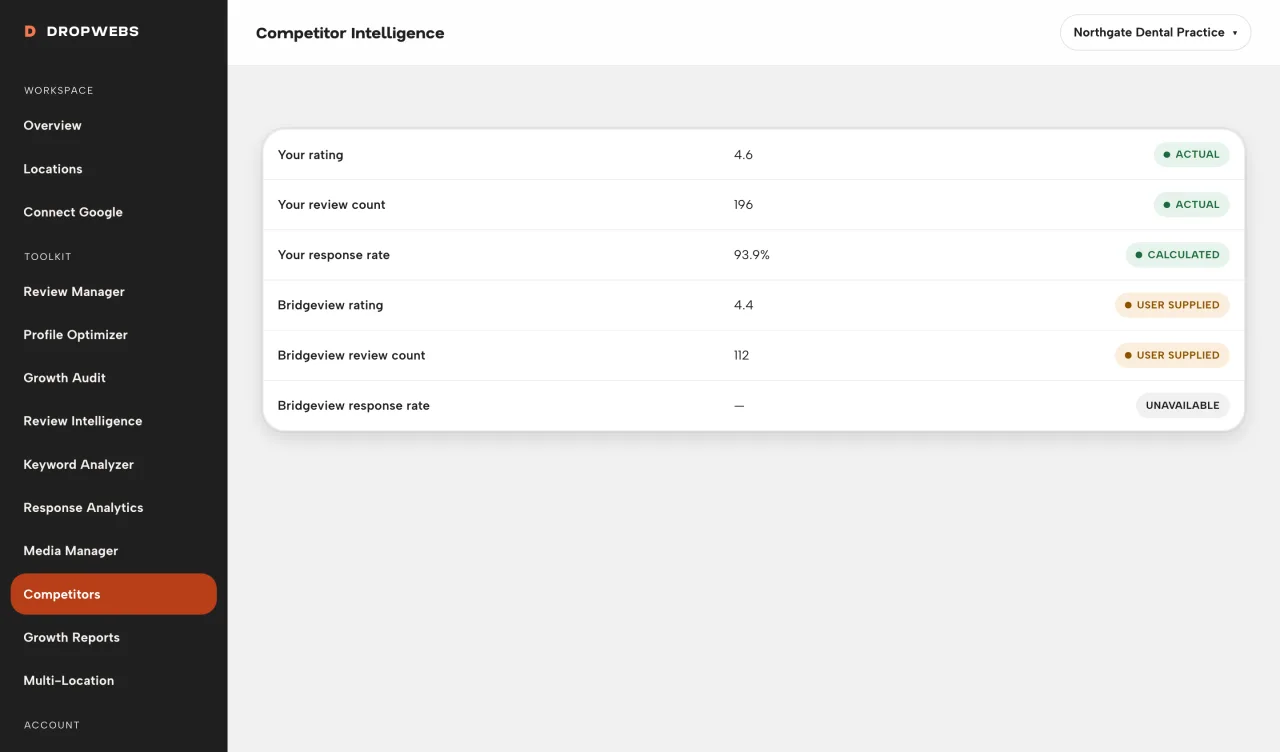
Competitor comparison in Dropwebs with each field labelled actual, user supplied, estimated or unavailable

Labelling

Actual, user-supplied, estimated, unavailable.

Every field carries its provenance on screen. You always know whether you are looking at something measured, something you typed in, something derived, or something nobody has. That labelling is what makes the comparison safe to put in a client report.

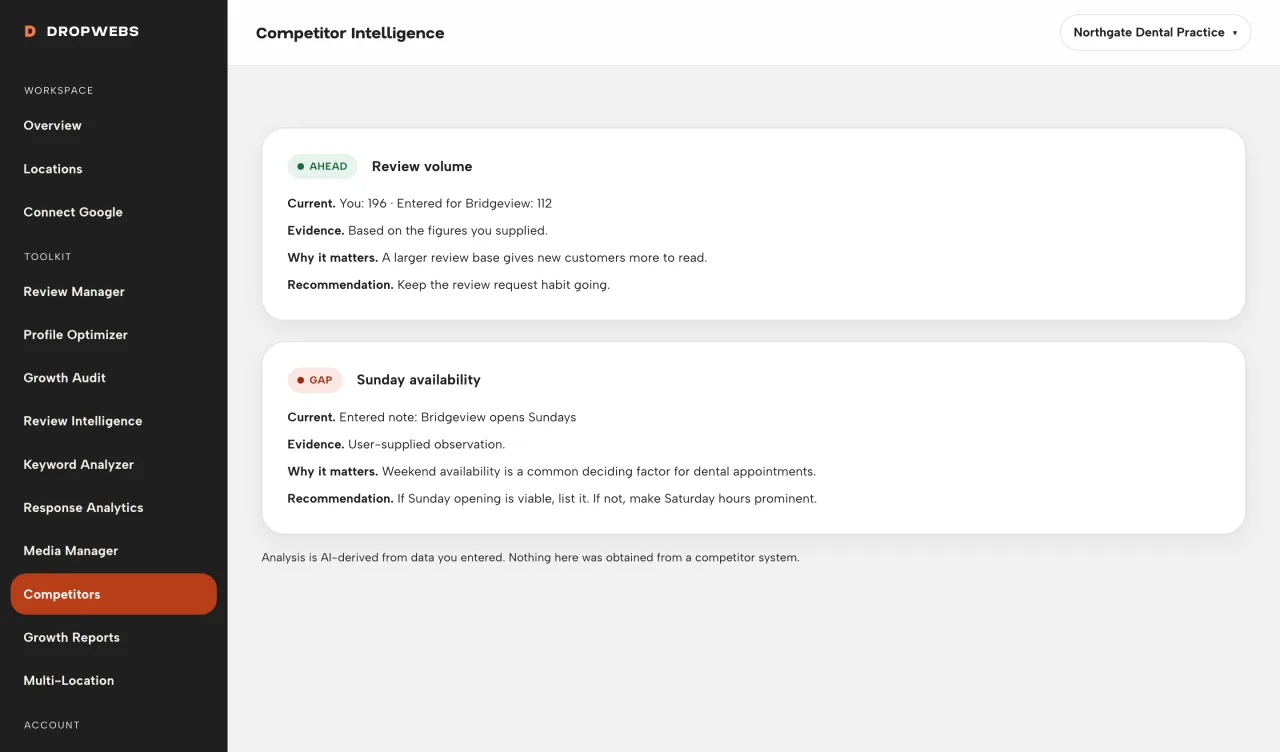
Competitive gap analysis in Dropwebs based on user supplied competitor data

Analysis

Where you are genuinely ahead or behind.

With the inputs labelled, the analysis is worth something: where your review volume, rating or response coverage sits against the set you entered, and which gaps are worth acting on. The conclusions are only ever as strong as the data you supplied, and the page says so.

How it works

From connection to result.

01

Step 1

Add a competitor name and public details.

02

Step 2

Label each field Actual, Estimated, or Unavailable.

03

Step 3

Compare against your synced rating and review counts.

04

Step 4

Use findings in Growth Audit or Keyword Analyzer.

What it gives back

A comparison that survives being questioned.

Safe

Nothing touches your Google account except the official connection you approved.

Defensible

Every field states where it came from.

Structured

A consistent frame instead of ad-hoc notes.

Isolated

Your competitor set is visible only to your account.

How to use it

Your first run, step by step.

01

Step 1

Add 1 - 3 local competitors you can verify publicly.

02

Step 2

Enter rating and review count only if you saw them; otherwise mark Unavailable.

03

Step 3

Optional: paste a few public review lines for theme extraction.

04

Step 4

Act on gaps: replies, profile, or keywords - not on invented rankings.

Limitations

What this tool cannot do.

Competitor figures are the public numbers you enter, not something Dropwebs obtained for you.

Competitor accuracy depends on the information you enter and how recently you refreshed it.

A competitor's internal metrics are not published by Google, so they are never shown here.

Questions

Straight answers about competitor intelligence.

What it does, what it will not do, and where the data comes from.

Where do competitor numbers come from?

From you. Open the competitor's public profile, note their rating and review count, and enter them. Every comparison then shows exactly which figures you supplied.

Can AI invent competitor ratings?

No. AI may analyze text you supply. Numbers must come from you with a source label.

Why do I have to type competitor data in?

Because you can see a competitor's public rating and review count yourself in about thirty seconds, and then you know exactly what the comparison rests on. An estimate you did not make is one you cannot stand behind in a client meeting.

Can AI analyse the competitors I add?

Yes. Once you add a competitor, AI reads the gap between you and them and suggests where to focus. The analysis is labelled AI-derived and works only from the figures you entered.

Get started

Try Competitor Intelligence on your own profile.

Free plan, no card. Connect Google and this tool has real data to work with in about a minute.

How to use it

Operator guide for Competitor Intelligence.

Workspace steps and real screens. This is a how-to, not a second overview of the tool.

Open the guide